
Anthropic’s Mythos Highlights the Cybersecurity Impact of AI-Accelerated Exploits
Summary
The article argues that Anthropic’s Mythos could accelerate vulnerability discovery, exploit creation and chaining, citing reported Mozilla Firefox testing and warning that defenders may need faster, AI-assisted discovery, response and patching.
Key points
- The article says Mythos found thousands of security-sensitive vulnerabilities in limited in-house testing, including one that had existed for more than 27 years.
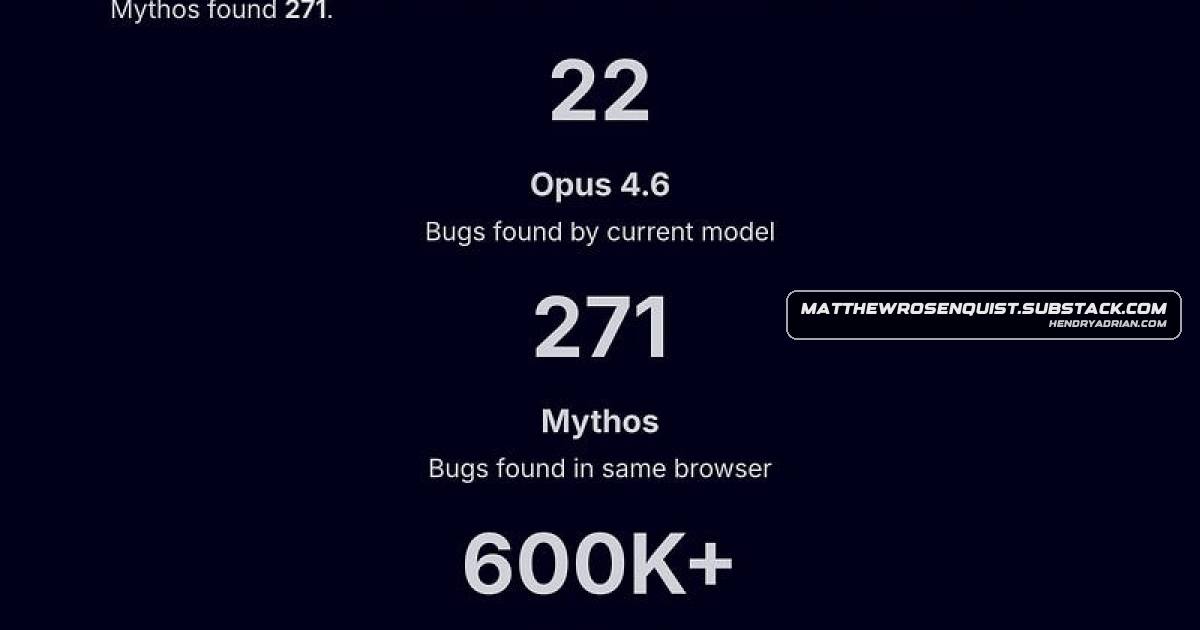
- It reports that Mozilla testing found 22 security-sensitive bugs with Opus 4.6 and 271 additional bugs with Mythos in a previous Firefox version.
- The author identifies vulnerability discovery, automated exploit creation and vulnerability chaining as capabilities that could speed attacks.
- The article projects more than 600,000 vulnerabilities in the year after widespread Mythos access, extrapolating from about 50,000 discovered in 2025; this is the author’s estimate, not a measured outcome.
- It argues that exploitation occurring within hours or days could outpace monthly patch cycles and strain security operations, incident response and patch teams.
- The author recommends AI-assisted vulnerability discovery and detection, faster response and more continuous patching, while noting that frequent updates could disrupt operations.
Article Details
- Topic
- Cybersecurity implications of AI-driven vulnerability discovery, exploit generation, and vulnerability chaining
Vendors
AnthropicAnthropic’s Mythos AI has rapidly discovered and enabled exploits for thousands of vulnerabilities across major operating systems and browsers, revealing risk at a scale far beyond current discovery processes.MicrosoftTake for example Microsoft’s Patch Tuesday, which occurs on the 2nd Tuesday of every month.MozillaOne of the partners, Mozilla, used Mythos to evaluate its popular Firefox browser.
Products
Mozilla FirefoxOne of the partners, Mozilla, used Mythos to evaluate its popular Firefox browser.MythosAnthropic’s Mythos AI has rapidly discovered and enabled exploits for thousands of vulnerabilities across major operating systems and browsers, revealing risk at a scale far beyond current discovery processes.Opus 4.6Anthropic’s current model, Opus 4.6, identified 22 security-sensitive bugs in the previous version that were patched.
Industries
GovernmentThe White House also called in Anthropic to discuss the risks to government agencies, departments, and national critical infrastructures.HealthcareSoftware developers, cybersecurity, every industryâ—âincluding critical infrastructures like healthcare, telecommunications, transportation, and power.Shipping and Logisticsattacks against adversaries’ critical infrastructures, like power, water, telecommunications, shipping and logistics, and government services.TelecommunicationsSoftware developers, cybersecurity, every industryâ—âincluding critical infrastructures like healthcare, telecommunications, transportation, and power.TransportationSoftware developers, cybersecurity, every industryâ—âincluding critical infrastructures like healthcare, telecommunications, transportation, and power.