Acronis’ May 2026 Update Reports Malware Trends and Instructure Breach
Summary
Acronis’s May 2026 update reports malware and URL detection trends and details the Instructure breach, in which attackers stole user data and exploited Canvas XSS vulnerabilities, prompting access revocation, patches and other response measures.
Key points
- Instructure confirmed data theft in an attack later claimed by ShinyHunters; the group claimed to have taken 280 million records, while Instructure said exposed data included names, email addresses, student IDs and user messages.
- Later reporting said attackers exploited XSS vulnerabilities in Canvas Free-for-Teacher to obtain authenticated admin sessions and deface login pages at about 330 institutions, briefly disrupting access.
- Instructure revoked unauthorized access, engaged forensic experts, deployed patches, increased monitoring, rotated application keys and temporarily shut down Free-for-Teacher accounts.
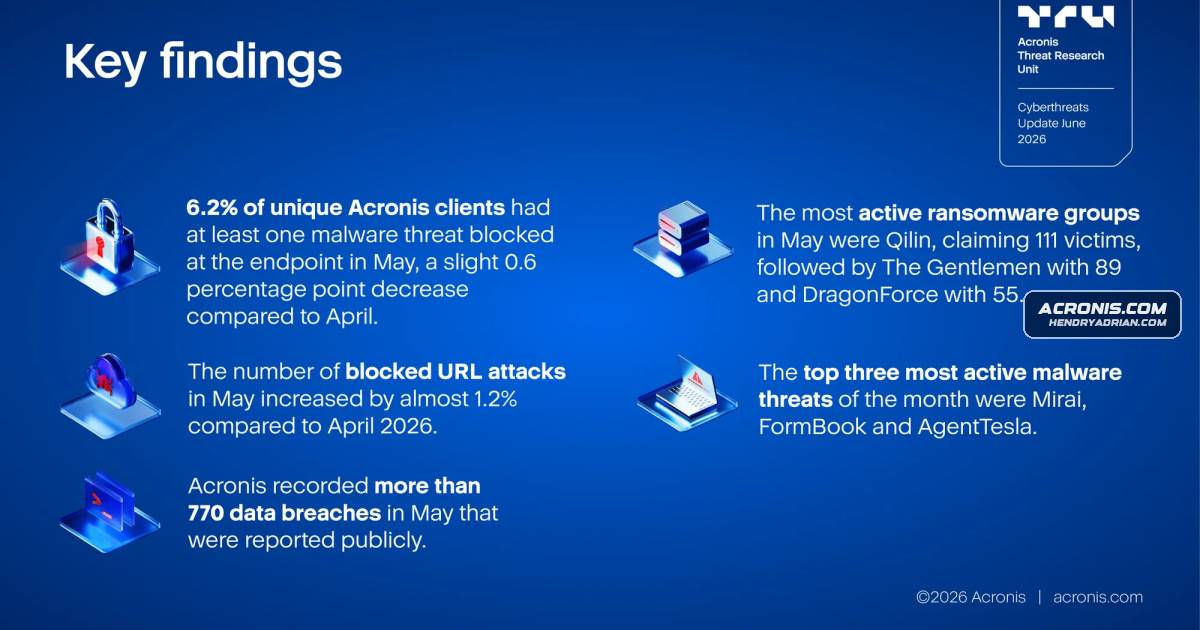
- Acronis reported that 6.2% of its unique clients had at least one endpoint malware threat blocked in May, down from 6.8% in April but above early-2026 levels.
- Palestine, Vietnam and Iraq had the highest reported malware detection rates, at 45.5%, 32.2% and 27.4%, respectively; each rate fell from April.
- Singapore had the highest normalized URL detection rate among the focus countries at 13.1%; New Zealand recorded the largest monthly increase, while South Korea had the sharpest decrease.
Article Details
- Publisher
- Acronis Threat Research Unit (TRU)
- Report Period
- May 2026
- Scope
- Threat activity observed by Acronis TRU and Acronis sensors, plus public-domain reporting; includes malware and URL detection rates and the Instructure incident.
- Key Statistics
- 6.2% of unique Acronis clients had at least one malware threat blocked at the endpoint in May 2026, down from 6.8% in April.
- Malware detection rates were 45.5% in Palestine, 32.2% in Vietnam, and 27.4% in Iraq in May 2026.
- The reported Instructure attack was claimed by ShinyHunters to involve 280 million records tied to 8,809 colleges, school districts, and online education platforms; these figures are attacker claims.
- Approximately 330 institutions were affected by Canvas login-portal defacements, according to the article.
- Recommendations
- Use strong vendor-risk monitoring, rapid incident communication, API and integration oversight, and response plans for third-party breaches.
- Use additional email security and URL filtering to help protect against social engineering threats.
People
Threat Actors
Vendors
Products
Acronis Cyber Protect CloudAcronis Cyber Protect Cloud protects against both known and never-before-seenAcronis GenAI Protectioncan help you protect against social engineering threats. Acronis GenAI Protection, natively integrated in the Acronis platform, gives youAcronis XDRharmful prompts. Acronis XDR for Acronis Cyber ProtectCanvastechnology provider Instructure, the company behind the widely used CanvasFree-for-Teacheraffecting Canvas’ Free-for-Teacher environment to obtain authenticated admin
Countries
AustraliaApril to 12.7% in May, up 3.3 percentage points. Australia also increased fromBrazilby Brazil at 13% and Colombia and New Zealand, both at 12.7%.Canada6.9% to 7.7%, respectively. Canada and Colombia each increased by 0.5Colombiaby Brazil at 13% and Colombia and New Zealand, both at 12.7%.France8.5% to 9.7%, while France rose from 10.1% to 11.1%. Japan and the UnitedGermanypoints. Germany declined from 11.1% to 10.7%, India from 11.3% to 11.1%, andIndiapoints. Germany declined from 11.1% to 10.7%, India from 11.3% to 11.1%, andIraqat 32.2% and Iraq at 27.4%.Italyseveral countries showed signs of stabilization or decline. Singapore and ItalyJapan8.5% to 9.7%, while France rose from 10.1% to 11.1%. Japan and the UnitedMexicoMexico edged down from 8.6% to 8.5%.New Zealandby Brazil at 13% and Colombia and New Zealand, both at 12.7%.Palestineto April. Palestine recorded the highest rate globally, with 45.5% of affectedSingaporenormalized URL detection rates, while several markets declined. SingaporeSouth Korearemained unchanged at 13.1% and 11.5%, respectively. South Korea recorded theUnited KingdomUnited Statespercentage points, while Brazil and the United States posted smaller increasesVietnamunique clients experiencing at least one malware detection, followed by Vietnam