Mandiant Outlines Guardrails for AI-Assisted Vulnerability Management
Summary
Mandiant recommends combining AI agents with deterministic controls and human oversight to manage vulnerabilities safely, including sandboxing agents, restricting privileges, validating findings, and reviewing AI-generated fixes.
Key points
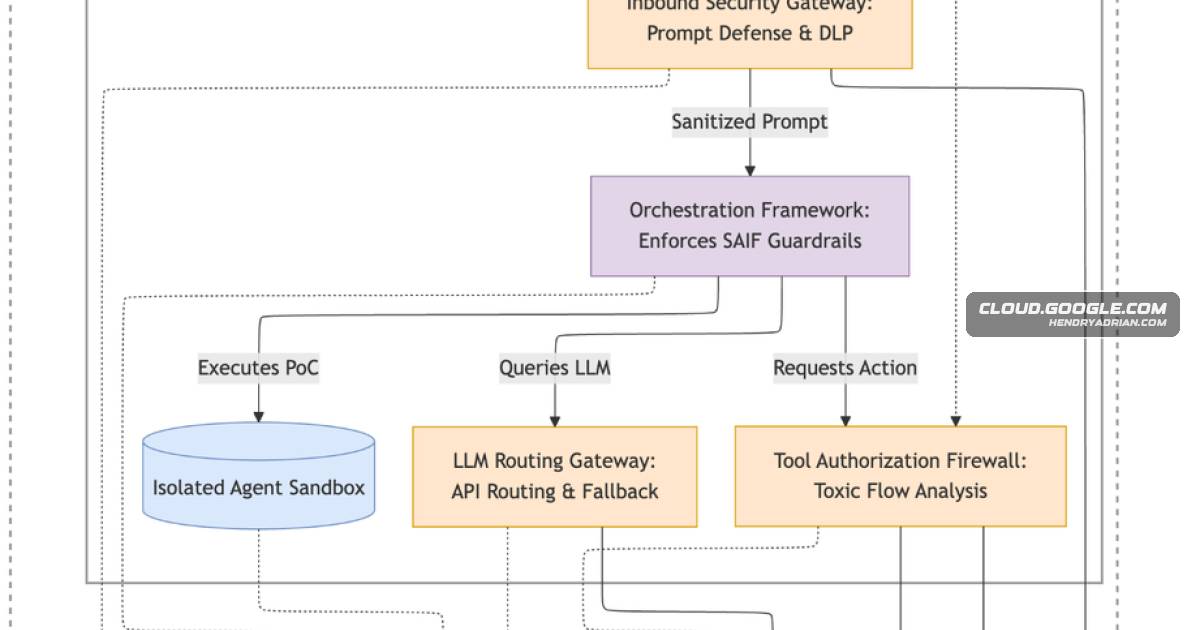
- Treat code, third-party dependencies, and agent integrations as untrusted inputs; filter prompt injections and sensitive data before they reach agents.
- Run agents in isolated, unprivileged environments with narrowly scoped, short-lived credentials, and monitor and log their actions.
- Use risk-based vulnerability management to prioritize findings by vulnerability severity, asset context, and real-world threat activity.
- AI agents are better suited to vulnerabilities with clear, observable outcomes; complex business-logic flaws still require human architectural review.
- Require reproducible tests in monitored sandboxes to validate agent findings, with timeouts and iteration limits to control resource use.
- Keep human review for findings and AI-generated fixes; use regression tests, rollback controls, and audit logs before and after deployment.
- Maintain foundational security controls and deterministic SAST/DAST, since AI-assisted discovery does not guarantee complete coverage.
Article Details
- Defense Focus
- Safely integrate AI agents into vulnerability discovery and remediation using isolation, least privilege, deterministic validation, human review, and risk-based prioritization.
- Detection Methods
- Normalize and deduplicate findings from EASM, CSPM, CTEM, and traditional scanners; enrich them with current asset context and threat intelligence to prioritize remediation.
- Use SAST and DAST for baseline code checks, and reserve intensive AI-agent audits for high-impact components where findings can be validated with observable outcomes.
- Require agents to produce reproducible test harnesses and run them automatically in isolated, monitored sandboxes with execution timeouts and iteration limits.
- Have a human review sandbox-confirmed findings for reachability, environmental context, and business impact.
- Monitor agent inputs, actions, reasoning, and outputs at runtime; use centralized logging to trace and restrict data flows to external endpoints.
- Monitor production workload behavior and the runtime libraries executing in production, not only static software inventories.
- Data Sources
- Normalized vulnerability findings from traditional scanners, EASM, CSPM, and CTEM
- Updated CMDB and asset context, including exposure and data sensitivity
- Threat intelligence and exploitation telemetry, including EPSS probabilities
- Source code, dependencies, and SAST findings
- Sandbox execution results and deterministic test-harness outcomes
- Runtime workload and library telemetry
- AI-agent inputs, actions, outputs, and audit logs
- Rule Types
- Deterministic SAST and DAST checks
- Deterministic policy-engine controls
- Schema validation for inbound application and API traffic
- Automated regression tests and exploit-validation test harnesses
- Weighted risk-based vulnerability scoring
- Platforms
- Isolated, monitored sandboxes
- CI/CD pipelines and runners
- IDE-integrated development environments
- EDR platforms
- SOAR platforms
- Defensive Actions
- Keep agents away from sensitive data; test with synthetic data in non-production environments and filter sensitive data and malicious prompt injections before they reach agents.
- Treat code, third-party dependencies, skills, and MCP integrations as untrusted inputs; vet tool integrity and monitor agent behavior at runtime.
- Run agents in isolated, unprivileged containers with dynamically limited privileges; use distinct, scoped machine identities and short-lived, repository- and branch-bound tokens.
- Use zero-data-retention agreements with LLM providers and establish authorized testing rules of engagement.
- Apply human-led threat modeling during design and architecture reviews, and red-team AI agents before deployment.
- Prioritize remediation using current asset context and threat intelligence; enforce patching SLOs and document risk acceptance for exceptions.
- Restrict remediation agents to proposing pull requests; run regression suites and the original proof-of-concept against proposed fixes, then require human approval.
- Use immutable audit logs, pin model API versions, and maintain deterministic regression suites and automated rollback capability.
People
Vendors
GoogleFrameworks like Google’s Secure AI Framework (SAIF) and Google’s approach to secure AI Agents provide a practical path forward, demanding that organizations extend existing deterministic controls directly into the AIMandiantAs highlighted in the Mandiant M-Trends 2026 report, the mean time-to-exploit (TTE) has dropped to -7 days, meaning vulnerabilities are often exploited a week before a patch even exists.
Products
CodeMenderExamples include CodeMender, although as of time of writing, it is not publicly available.Google Assured Open Source Software (OSS)a centralized artifact repository equipped with automated curation services, such as Google Assured Open Source Software (OSS) or an equivalent solution, preventing untrusted code from entering the developmentModel Armoras chokepoints, alongside Layer 2 reasoning-based defenses like specialized guard models (such as Model Armor or similar provider-agnostic guardrails) to filter out sensitive data and block malicious promptWizIn hybrid and cloud environments, tools like Wiz can be used to map this initial footprint.