
PoC Exploit Targets DirtyDecrypt Linux Kernel Privilege-Escalation Flaw
Summary
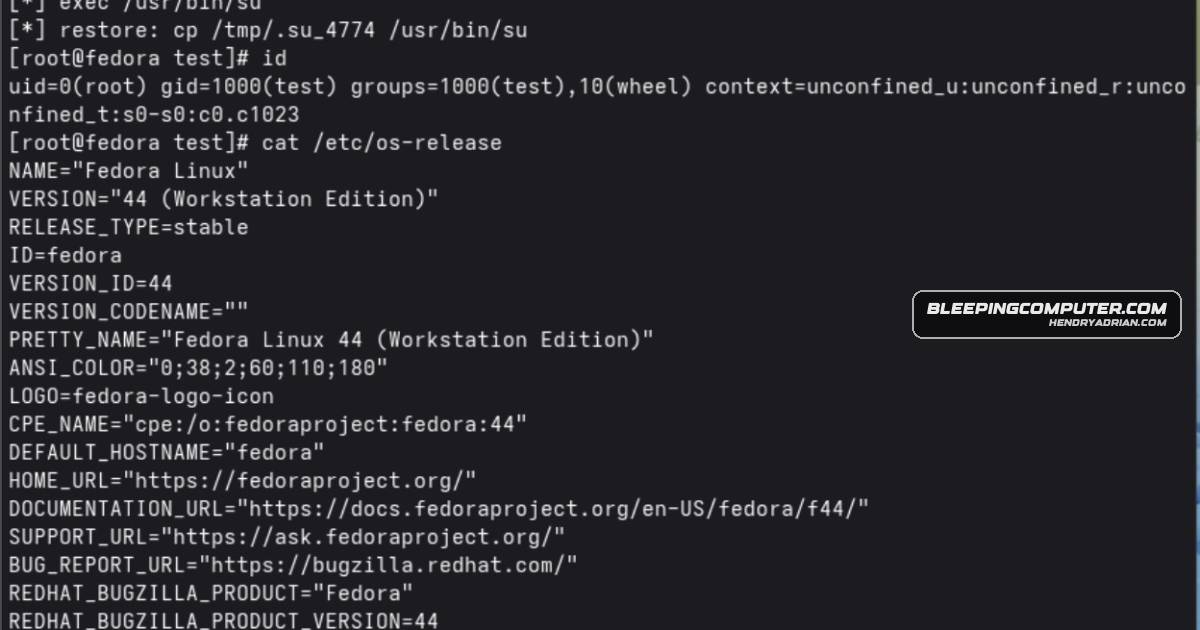
A proof-of-concept for the patched DirtyDecrypt (DirtyCBC) Linux kernel privilege-escalation flaw can grant root on systems with CONFIG_RXGK enabled. Researchers say it aligns with CVE-2026-31635; users are urged to update or apply a temporary mitigation.
Key points
- The flaw involves an rxgk page-cache write caused by a missing copy-on-write guard in rxgk_decrypt_skb, according to the V12 security team.
- V12 said it reported the issue on May 9, 2026, but maintainers identified it as a duplicate that had already been patched in the mainline kernel.
- There is no official CVE ID for DirtyDecrypt; vulnerability analyst Will Dormann said the details align with CVE-2026-31635, patched on April 25.
- Exploitation requires a Linux kernel built with CONFIG_RXGK, which enables RxGK support for the AFS client and network transport.
- Fedora, Arch Linux, and openSUSE Tumbleweed are identified as likely affected distributions; the proof of concept was tested on Fedora and the mainline kernel.
- Users are advised to install kernel updates. The suggested temporary mitigation disables esp4, esp6, and rxrpc modules, but breaks IPsec VPNs and AFS file systems.
Article Details
- Vulnerability Types
- Local privilege escalation
- rxgk page-cache write caused by a missing COW guard in rxgk_decrypt_skb
- Severity
- Unknown
- Exploitation Status
- unknown
- Exploit Availability
- public_poc
- Patch Status
- available
- Workarounds
- The article recommends applying the Dirty Frag mitigation by disabling and unloading the esp4, esp6, and rxrpc modules. It warns that this breaks IPsec VPNs and AFS distributed network file systems.
MITRE ATT&CK
CVE
People
Products
Arch LinuxThe issue affects kernels built with CONFIG_RXGK, with Fedora, Arch Linux, and openSUSE Tumbleweed among the most likely targets, while users are urged to patch quickly or apply the temporary mitigation.FedoraThe issue affects kernels built with CONFIG_RXGK, with Fedora, Arch Linux, and openSUSE Tumbleweed among the most likely targets, while users are urged to patch quickly or apply the temporary mitigation.Linux kernelA newly patched Linux kernel rxgk local privilege escalation flaw, dubbed DirtyDecrypt or DirtyCBC, now has a proof-of-concept exploit that can grant root access on some systems.openSUSE TumbleweedThe issue affects kernels built with CONFIG_RXGK, with Fedora, Arch Linux, and openSUSE Tumbleweed among the most likely targets, while users are urged to patch quickly or apply the temporary mitigation.