
How STRIDE-AI, MAESTRO and ASTRIDE Extend Threat Modeling for AI Applications
Summary
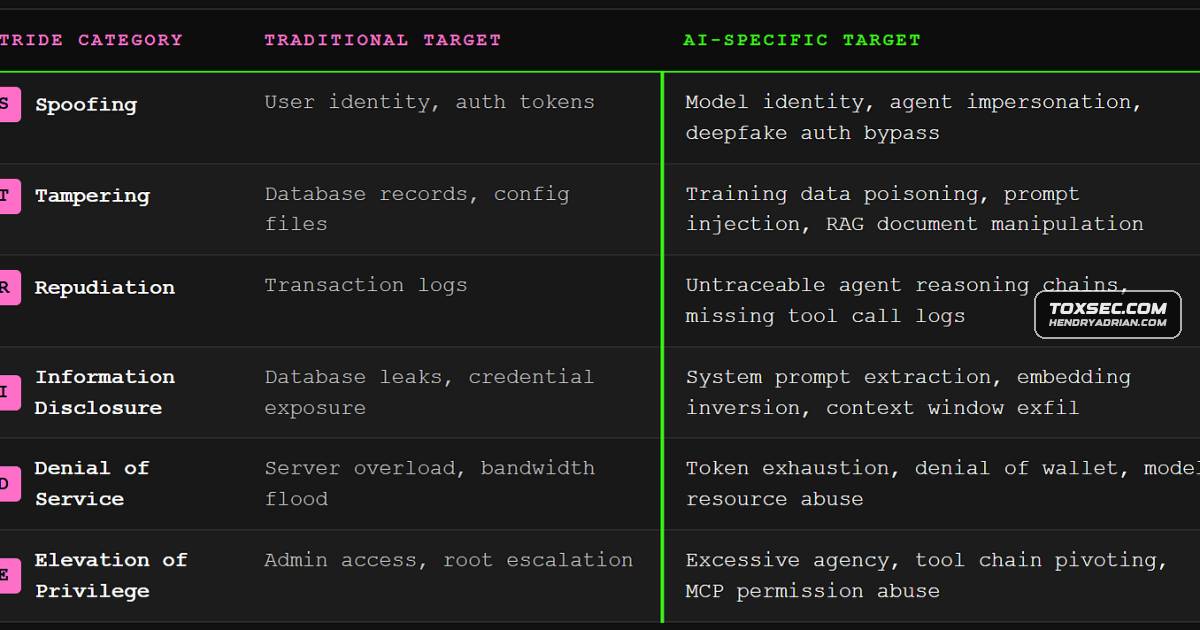
The article explains how AI changes traditional STRIDE threat modeling and introduces STRIDE-AI, ASTRIDE and MAESTRO, with examples and questions for assessing risks across AI models, data, prompts and agent tools.
Key points
- The article argues that AI non-determinism and blurred trust boundaries require adapting traditional STRIDE threat categories.
- It maps spoofing risks to trojaned models and agents that impersonate trusted identities, and tampering risks to training-data poisoning, prompt injection and RAG document poisoning.
- It highlights audit gaps in agent workflows, including missing records of tool calls, retrieved context and the prompts active when decisions were made.
- It describes AI information-disclosure risks including system-prompt extraction, embedding inversion and context exfiltration through tool access.
- It identifies denial of wallet and excessive agency as risks from costly model workflows and agents with overly broad tool permissions.
- STRIDE-AI maps threats to ML assets, ASTRIDE adds an agent-specific threat category, and MAESTRO evaluates threats across AI architecture layers.
Article Details
- Topic
- Adapting STRIDE threat modeling for AI applications and agentic systems