
Silent Push Explains How Its Context Graph Flags Staged Adversary Infrastructure
Summary
Silent Push says its Context Graph identified a Salt Typhoon-related infrastructure cluster in May 2025, before public disclosure in October. The article describes its DNS and infrastructure signals, IOFA, and integrations for earlier blocking and investigation.
Key points
- Silent Push says its proprietary Passive-Aggressive DNS (PADNS) re-resolves hostnames daily and combines DNS, WHOIS, host scans, certificates, honeypot interactions and ASN data to identify infrastructure it considers potentially adversary-controlled.
- The company says it identified the same Salt Typhoon-related infrastructure cluster in May 2025, before public findings in October; this is a vendor-reported claim, not independent confirmation in the article.
- Silent Push describes Indicators of Future Attack (IOFA) as complementary to IOCs: IOFA flags infrastructure being staged, while IOCs record infrastructure already used.
- The article says Context Graph data can feed SIEM, SOAR and endpoint detection lists, enrich alerts, and support automated response workflows.
- Silent Push says 10,000 external IP addresses and domains observed in enterprise telemetry were enough to seed its infrastructure-monitoring loop.
- The company presents deterministic DNS, certificate, WHOIS and behavioral data as a basis for AI-assisted infrastructure pivots and investigation.
Article Details
- Topic
- Pre-weaponization detection of adversary infrastructure using Indicators of Future Attack (IOFA)
MITRE ATT&CK
Threat Actors
Vendors
Products
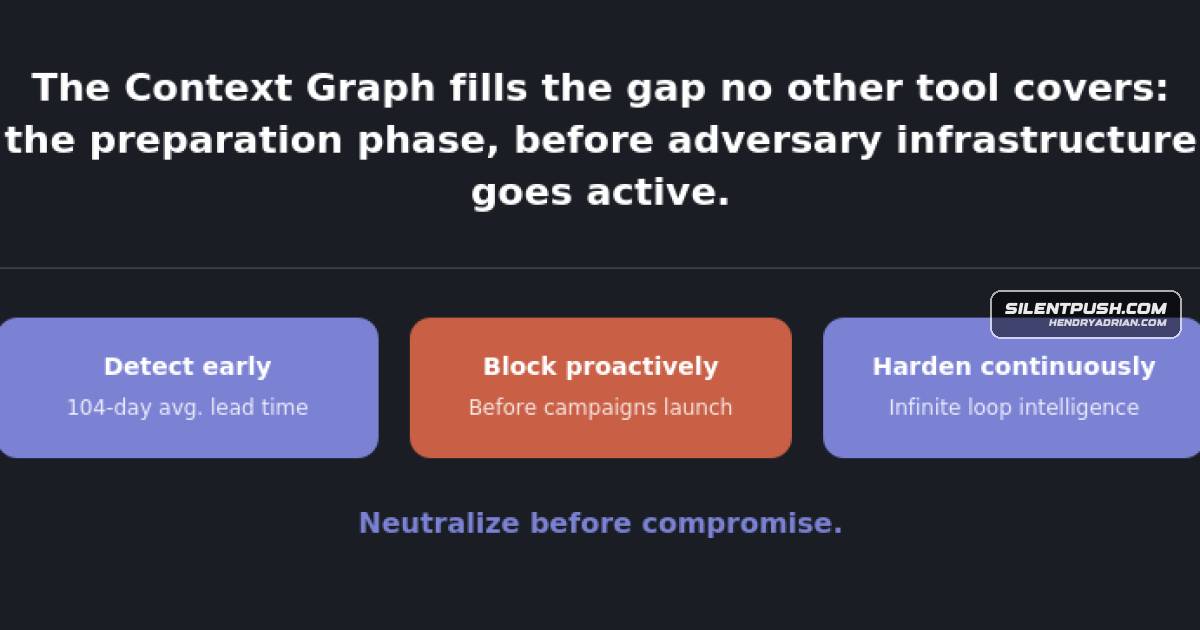
Context GraphSilent Push says traditional threat intelligence mostly sees attacks after they happen, while the Context Graph is designed to surface adversary infrastructure during the preparation phase before weaponization.Threat Check APIOur Threat Check API provides high-throughput true/false verdicts on any indicator, short-circuiting enrichment queues and accelerating triage without adding manual steps.