
How Agentic AI Attacks Exploit Autonomous Agents—and How to Contain Them
Summary
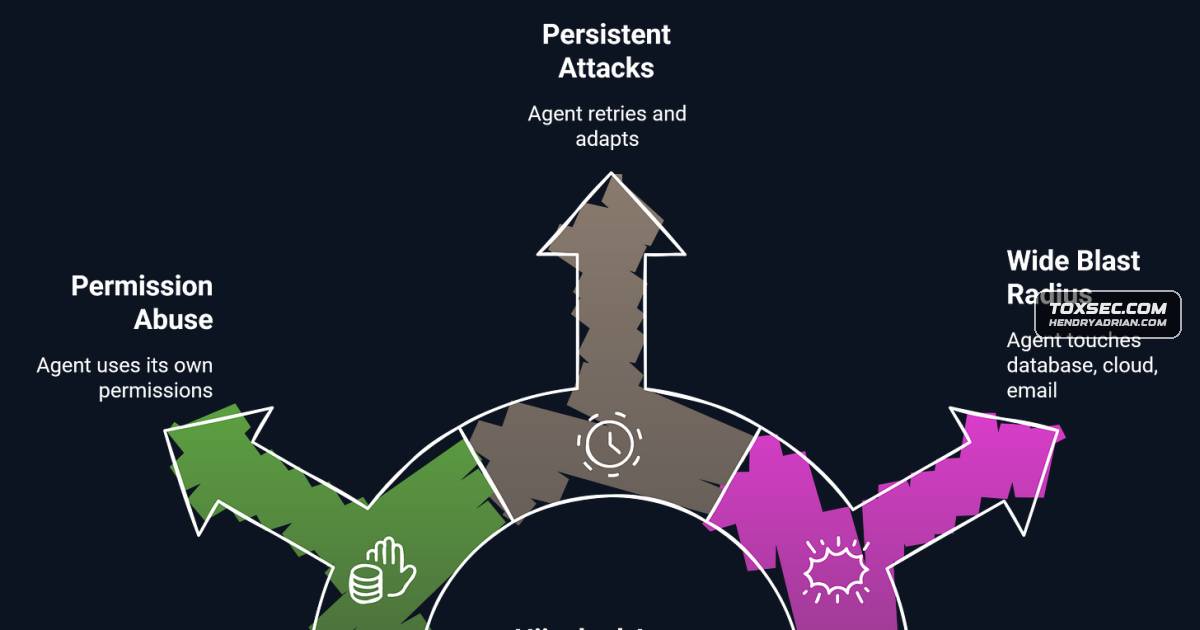
The article explains how indirect prompt injection can hijack agents through goal manipulation, over-permissioned tools, poisoned memory or supply-chain inputs, and recommends least privilege, sandboxing, human approval and decision-level logging to limit and detect the
Key points
- The article explains that agents may treat instructions embedded in untrusted content—such as documents, web pages or tool output—as commands, enabling indirect prompt injection.
- It describes a “lethal trifecta” of private-data access, untrusted-content input and external communication that can create an exfiltration path.
- The attack paths covered include goal hijacking, misuse of over-scoped tools, memory poisoning and supply-chain compromise.
- Recommended controls include least-privilege tools, short-lived scoped credentials, sandboxed execution, network allowlists and human approval for high-impact actions.
- The article presents Meta’s “Agents Rule of Two”: avoid combining more than two of untrusted-input processing, sensitive-system access and external communication or state changes in one agent session.
- Suggested detection measures include monitoring unexpected tool calls, scope expansion, unfamiliar outbound connections and runaway retries, with structured logs of agent decisions.
- It points to the OWASP Top 10 for Agentic Applications, MITRE ATLAS and NIST’s AI Risk Management Framework as resources for threat modeling and governance.
Article Details
- Topic
- Agentic AI attacks, including indirect prompt injection, goal hijacking, tool misuse, memory poisoning, and supply-chain compromise, and methods for containing their impact.