
CYFIRMA Analyzes 11 Suspicious npm Packages, Including moralis-sdk With 2.7M Downloads
Summary
CYFIRMA analyzed 11 malicious or highly suspicious npm packages targeting Web3 developers; moralis-sdk had over 2.7 million downloads. The report details wallet and credential theft, staged payloads, blockchain-based C2, and on-chain exfiltration.
Key points
- Researchers identified 11 malicious or highly suspicious npm packages across four clusters targeting blockchain developers, Web3 projects, and cryptocurrency infrastructure.
- The report gives moralis-sdk 2,717,472 downloads and describes its obfuscated post-install downloader; the final-stage payload was unavailable for analysis.
- Packages used typosquatting and npm preinstall or postinstall scripts to execute code during installation.
- The analyzed packages targeted wallet private keys, mnemonic phrases, SSH keys, cloud credentials, API tokens, and other developer secrets.
- Researchers describe Ethereum smart contracts used to retrieve infrastructure and Ethereum transactions used to exfiltrate encrypted credentials.
- The report recommends verifying dependencies, restricting lifecycle scripts where feasible, monitoring for credential theft, and rotating potentially exposed secrets.
Article Details
- Attack Vectors
- Malicious and typosquatted npm packages impersonated blockchain development libraries and used preinstall or postinstall lifecycle hooks to execute code during installation.
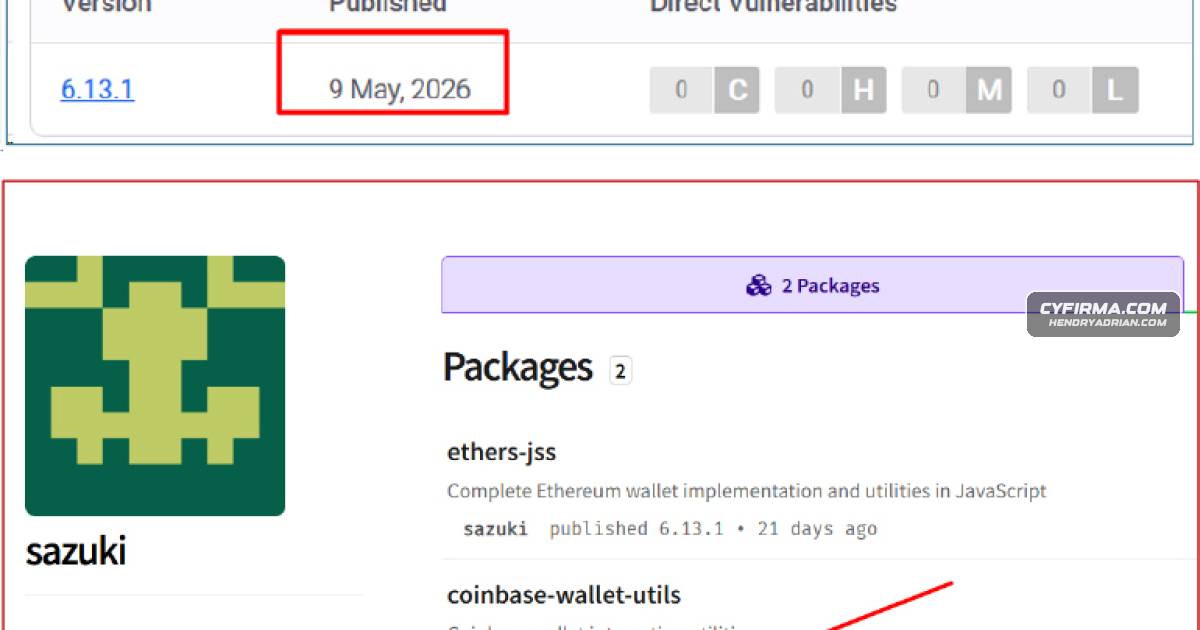
- The ethers-jss package intercepted wallet creation and recovery functions to capture private keys and mnemonic phrases, and searched environment variables, configuration files, and SSH directories for credentials.
- The coinbase-wallet-utils package collected host and environment information and sent it to an external C2 endpoint.
- The moralis-sdk package used a remote activation check and a multi-stage PowerShell downloader to retrieve and execute payloads, including a batch file hosted on remote services.
- Ganach, Solidty, and Stelar-sdk used Ethereum smart-contract lookups to retrieve infrastructure and download platform-specific payloads.
- Five packages published by the npm user ethcompat harvested cryptocurrency credentials and exfiltrated encrypted data in Ethereum transactions to an attacker-controlled wallet.
- Defensive Notes
- Verify package authenticity, maintainers, publication history, and repository ownership before installation; monitor for typosquatting and unexpected package updates.
- Disable npm lifecycle scripts where feasible, or use npm install --ignore-scripts; monitor preinstall and postinstall activity.
- Keep private keys, seed phrases, API tokens, and cloud credentials out of plaintext files; use dedicated secrets management and rotate credentials after suspected exposure.
- Apply least privilege to developer workstations and CI/CD environments, and monitor access to SSH keys, sensitive configuration files, and deployment secrets.
- Inspect outbound traffic for unauthorized communications to external infrastructure and monitor for credential collection and exfiltration, including blockchain transactions.
- Remove malicious packages from affected environments and review repositories, CI/CD pipelines, and infrastructure logs for post-compromise activity.
Indicators of compromise
| Type | Indicator | Context |
|---|---|---|
| SHA1 | 53b91117db931d3acbbfd15aa8400bb6691e023d | SHA1 of the ethers-jss package archive identified in the campaign. |
| SHA1 | 63154cd9c79f9d14eb9be6c4efc2a778d31646ec | SHA1 of the coinbase-wallet-utils package archive identified in the campaign. |
| SHA1 | 70842cfc27b116d0db2fd7aa33d53a3faf510993 | SHA1 of the Solidty package archive identified in the campaign. |
| SHA1 | 74d3d5ab6d0fa4c6a5860598231728a6a893ecf7 | SHA1 of the malicious moralis-sdk v1.0.1 package archive. |
| SHA1 | e1bdcd1a7157f7d047a88ab4573723fe1e861951 | SHA1 of the Stelar-sdk package archive identified in the campaign. |
| SHA1 | fcc8a542aad41e758cf6c18571048890be53808e | SHA1 of the Ganach package archive identified in the campaign. |
| SHA256 | 17bad5ae5b2ac262f5f18854853869840245c344105aa38c7f550ef51d2e5f26 | SHA256 of the malicious moralis-sdk v1.0.1 package archive. |
| SHA256 | 2fa5b0475c3b70a3ba14c6a3938baf441a08b11841493b85e087d1d5e01eba49 | SHA256 of the Stelar-sdk package archive identified in the campaign. |
| SHA256 | 5c50f79038b31aa8a3a68b24d8b783dfbd2e15fff7586c5609e544a717ef7d05 | SHA256 of the ethers-compat package archive identified in the campaign. |
| SHA256 | 6585ca0d3e26c20ced638f46f4a89eea924d411b8753d3fcf434663593c7cf0b | SHA256 of the coinbase-wallet-utils package archive identified in the campaign. |
| SHA256 | 7269c00a6164fd01dd516e0a72b2bd84c82e78feb552e06964e4992ff0479dda | SHA256 of the Ganach package archive identified in the campaign. |
| SHA256 | bab96257018df49ace8fe8adfadc74cf8327fcf9a9dc8a3a7c9ac8e18881df5f | SHA256 of the web3-deploy-helper package archive identified in the campaign. |
| SHA256 | d6abc7003b580472d808b338adef0b28eacc698cd4692f76cb2a91718ab78d88 | SHA256 of the hardhat-deploy-utils package archive identified in the campaign. |
| SHA256 | d7ec660a2a29c1aabcbe9bff1ef29be9a9fab8c7fe7c40df4772dd2b5bdf9666 | SHA256 of the defi-sdk-core package archive identified in the campaign. |
| SHA256 | d94a2444268b339dfda2615f7800322fb318e0a484414bb17016cfcd5eb07c44 | SHA256 of the ethers-jss package archive identified in the campaign. |
| SHA256 | e848d73a68e4e8aea00a6257552b5872907dfaf7cce3d94636d7e59d286edeab | SHA256 of the Solidty package archive identified in the campaign. |
| SHA256 | feabf10c8a9ba2775bb0f7f9d0b20203112b7df8e6d333a44d5a11eae0e38e86 | SHA256 of the ethereum-dev-utils package archive identified in the campaign. |
| URL | hxxp[:]//193[.]233[.]201[.]21:3001 | C2 and remote payload-distribution endpoint resolved through the malware's blockchain-based infrastructure lookup. |
| URL | hxxps[:]//pastefy[.]app/RhPBKGli/raw | Specific Pastefy resource identified as hosting a Base64-encoded PowerShell payload in the moralis-sdk infection chain. |
MITRE ATT&CK
T1027 · Obfuscated Files or InformationMalicious JavaScript and PowerShell content was obfuscated or Base64-encoded to conceal payload logic and URLs.T1033 · System Owner/User DiscoveryThe malware collected infected-system details including the current username and hostname.T1036.005 · Match Legitimate Resource Name or LocationPackages including Ganach, Solidty, Stelar-sdk, ethers-jss, and coinbase-wallet-utils were named to resemble legitimate blockchain tools and libraries.T1041 · Exfiltration Over C2 ChannelThe coinbase-wallet-utils and ethers-jss packages sent collected host or credential data to attacker-controlled infrastructure, including through HTTPS requests.T1059.001 · PowerShellThe moralis-sdk infection chain launched PowerShell with an encoded command to retrieve and execute additional payloads.T1059.003 · Windows Command ShellA downloaded batch file was executed silently through cmd.exe.T1082 · System Information DiscoveryThe malware collected host information including the hostname and operating-system platform.T1083 · File and Directory DiscoveryThe malware searched for sensitive configuration files and scanned the victim's .ssh directory for private keys.T1105 · Ingress Tool TransferThe downloader retrieved remote payloads, including platform-specific binaries and a batch file, from external infrastructure.T1140 · Deobfuscate/Decode Files or InformationThe infection chain decoded Base64-encoded URLs and payload content to recover and execute later-stage scripts.T1195.002 · Compromise Software Supply ChainThe campaign distributed trojanized and typosquatted npm packages through the npm registry to compromise developers.T1518 · Software DiscoveryThe article reports that the malware identified development environments and blockchain tooling.T1528 · Steal Application Access TokenThe campaign targeted access tokens and keys including NPM_TOKEN, GITHUB_TOKEN, AWS keys, Infura keys, and Alchemy keys.T1552 · Unsecured CredentialsPackages searched environment variables and developer configuration and secret files for credentials, private keys, and tokens.
Products
Industries
Blockchain and Web3The widespread adoption of open-source software has significantly accelerated innovation across blockchain and Web3 ecosystems.Cryptocurrencysupply chain campaign using 11 malicious packages to target blockchain developers, Web3 projects, and cryptocurrency infrastructure, with moralis-sdk alone reaching more than 2.7 million downloads.