
Predictable Session-Cookie Secret Enabled Impersonation of 95 Accounts in Authorized Testing
Summary
Researchers found that a hard-coded cookie-signing secret and publicly exposed user IDs let them forge sessions for 95 of 241 tested accounts, including administrators, in an authorized staging assessment, bypassing application-level SSO and MFA.
Key points
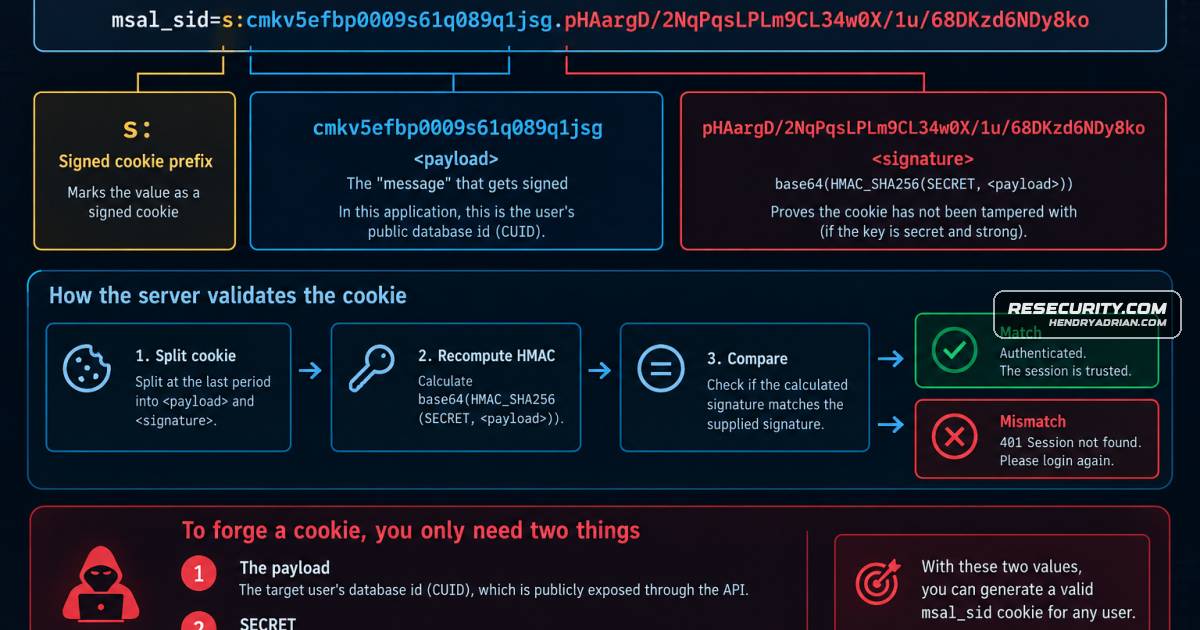
- The session cookie used a hard-coded, predictable HMAC-SHA256 signing secret identical to the cookie name; researchers recovered it by testing about 110 candidates.
- The signed payload was a user's public database ID, exposed through API responses, rather than a random session identifier.
- Researchers forged sessions without a victim's password, MFA challenge, or Entra ID access token.
- Forged sessions worked for 95 of 241 tested user IDs, including administrator accounts; read/write access and an administrative state-changing action were demonstrated.
- Testing was authorized and limited to the vendor's staging environment; no production systems were touched, and test records were restored.
- Recommended fixes include rotating the secret, using random server-generated session IDs backed by server-side session state, invalidating existing sessions, and reviewing authentication logs.
Article Details
- Attack Vectors
- The application's session cookie used the user's publicly exposed database ID as its signed payload and a hard-coded signing secret identical to the cookie name, session_secret_example.
- During authorized testing, Resecurity recovered the signing secret by testing approximately 110 candidate values offline against a captured legitimate cookie, then generated valid HMAC-SHA256 signatures for other user IDs.
- User IDs were available in API responses, including /api/v1/auth/me, user list and detail endpoints, and user-directory endpoints.
- The application accepted forged session cookies without requiring the victim's password, MFA challenge, or Entra ID access token. Testing demonstrated impersonation of employee and administrator accounts, including a state-changing administrative action.
- The unauthenticated Swagger UI at /api-docs/ exposed the API route surface, according to the article.
- Defensive Notes
- Immediately rotate the session signing secret and invalidate existing sessions.
- Replace public user IDs in cookies with random, unpredictable, server-generated session identifiers backed by server-side session state.
- Generate a strong, unpredictable signing secret, store it securely, and use separate secrets for development, staging, and production.
- If stateless tokens are required, use strong cryptographic keys, appropriate expiration and replay protections, and do not rely solely on a publicly exposed identifier for identity.
- Review authentication logs for unusual session creation, account impersonation, administrative actions, and activity associated with unexpected user accounts.