
SearchLeak Flaw Could Expose Microsoft 365 Copilot Data With One Click
Summary
Varonis Threat Labs described SearchLeak, a one-click flaw in Microsoft 365 Copilot Enterprise Search that could expose emails, MFA codes, calendar data and indexed files. Microsoft mitigated it; researchers presented a proof of concept, with no observed exploitation.
Key points
- SearchLeak used a crafted Copilot Enterprise Search q parameter to trigger prompt injection without requiring the victim to enter a prompt.
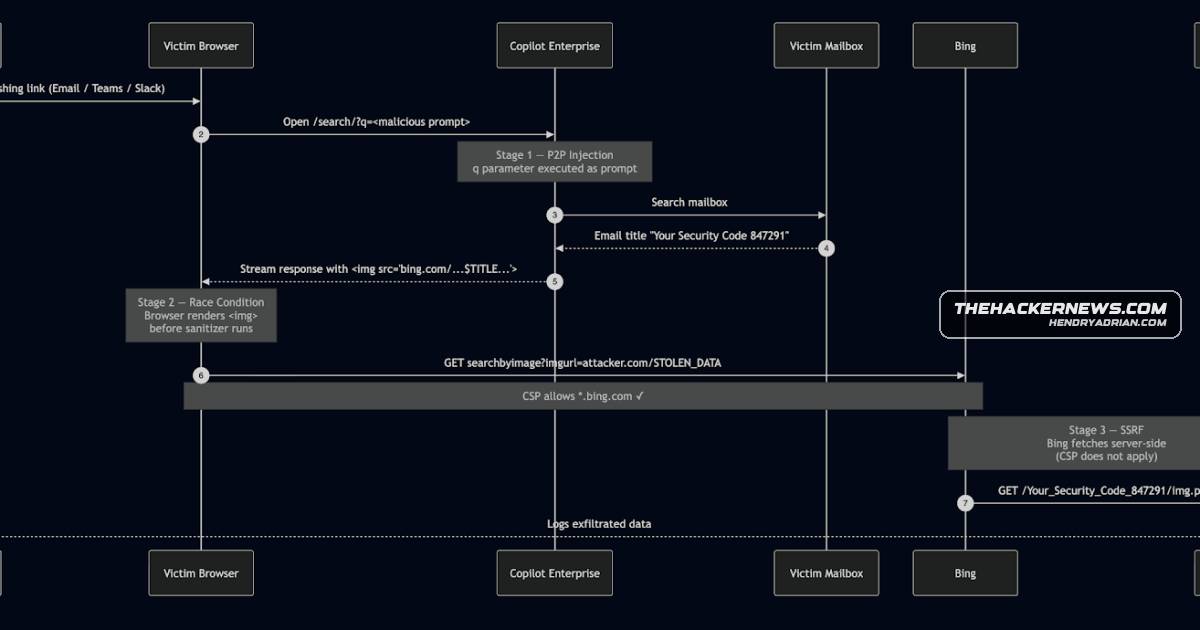
- The attack chain combined prompt injection, a rendering race that let injected markup run before sanitization, and Bing image fetching to relay data to an attacker-controlled server.
- Potentially exposed information included emails, MFA codes, password-reset links, calendar details, and indexed SharePoint or OneDrive files.
- Varonis said the trusted link used a real microsoft[.]com domain, making it less likely to be flagged by conventional URL filtering.
- Microsoft assigned CVE-2026-42824 and mitigated the flaw on its backend; the article says Varonis demonstrated a proof of concept, not observed exploitation.
- Defenders can monitor Copilot Search q parameters for encoded payloads or HTML and watch for unusual outbound requests to Bing image endpoints.
Article Details
- Attack Vectors
- A crafted Copilot Enterprise Search URL used the q parameter to make Copilot treat attacker-supplied text as instructions and search the signed-in user's data.
- A rendering race allowed an injected image tag to send a request before the output sanitizer neutralized it.
- The proof of concept used Bing's allowlisted image-fetch endpoint to retrieve an attacker-server URL containing stolen text, bypassing the browser's Content Security Policy.
- The attack required the victim to click a link; the article reports a proof of concept, not observed exploitation.
- Defensive Notes
- Monitor Copilot Search URLs for encoded payloads or HTML in the q parameter.
- Monitor for unusual outbound requests to Bing image endpoints.
- Tighten data-access governance to limit the data Copilot indexes.
MITRE ATT&CK
CVE
CVE-2025-32711Microsoft · Microsoft 365 CopilotThe same pattern showed up in EchoLeak (CVE-2025-32711), the zero-click Copilot data-leak bug Aim Security disclosed in 2025.CVE-2026-42824Microsoft · Microsoft 365 CopilotMicrosoft assigned CVE-2026-42824 and mitigated the issue on the backend, while defenders are advised to monitor suspicious q-parameter payloads and unusual Bing image requests.
People
Vendors
Products
BingMicrosoft assigned CVE-2026-42824 and mitigated the issue on the backend, while defenders are advised to monitor suspicious q-parameter payloads and unusual Bing image requests.Microsoft 365 CopilotVaronis Threat Labs uncovered SearchLeak, a one-click attack chain against Microsoft 365 Copilot Enterprise Search that could exfiltrate emails, calendar details, and indexed files through a trusted microsoft.com link.Microsoft 365 Copilot Enterprise SearchVaronis Threat Labs uncovered SearchLeak, a one-click attack chain against Microsoft 365 Copilot Enterprise Search that could exfiltrate emails, calendar details, and indexed files through a trusted microsoft.com link.Microsoft GraphCopilot Enterprise can reach whatever the signed-in user can, through their Microsoft Graph access, and the attacker inherits that reach without ever logging in.Microsoft OneDriveAttackers could steal MFA codes, password-reset links, calendar data, and SharePoint or OneDrive files.Microsoft SharePointAttackers could steal MFA codes, password-reset links, calendar data, and SharePoint or OneDrive files.