
AutoJack Uses AI Browsing Agent to Trigger Host RCE in AutoGen Studio Pre-Releases
Summary
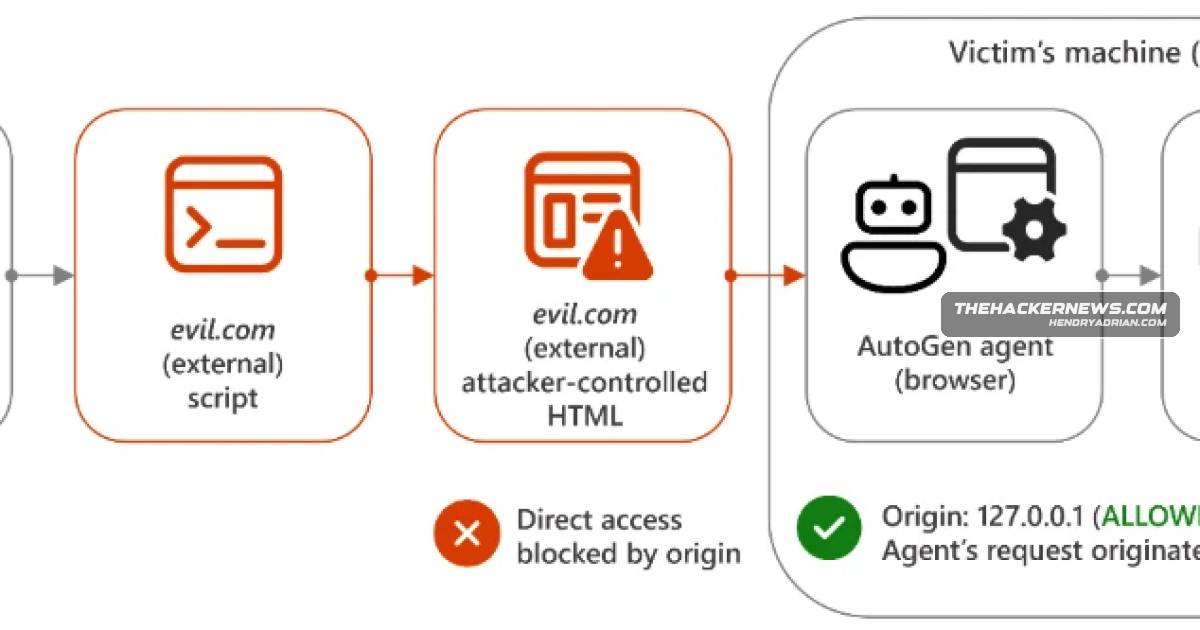
AutoJack chains localhost trust, skipped authentication, and unauthenticated command execution in AutoGen Studio prereleases to let a page loaded by an AI browsing agent trigger host code execution. Stable 0.4.2.2 is unaffected; a fix is in the main branch.
Key points
- A page loaded by a local AI browsing agent can reach AutoGen Studio’s MCP WebSocket service and run an attacker-chosen command under the Studio process account.
- The chain relies on a localhost trust check, MCP routes skipped by authentication middleware, and an endpoint that executes a command supplied in a request parameter.
- The vulnerable route was present in prereleases 0.4.3.dev1 and 0.4.3.dev2. Stable release 0.4.2.2 has no MCP route and is unaffected.
- Microsoft described AutoJack as research and reported no exploitation in the wild; its proof of concept launched calc.exe through a Web Content Summarizer agent.
- The maintainers hardened the main branch at commit b047730: commands are no longer read from the URL, session IDs are checked, and MCP routes use normal authentication. No fixed PyPI release was available in the article.
- For affected prerelease users, the article recommends using the fixed main-branch code. It also advises separating AutoGen Studio from agents handling untrusted content, or isolating them in containers or VMs.
Article Details
- Attack Vectors
- An attacker-controlled web page loaded by a local AI browsing agent uses JavaScript to reach AutoGen Studio's localhost MCP WebSocket route.
- In vulnerable pre-release builds 0.4.3.dev1 and 0.4.3.dev2, the MCP route accepted unauthenticated connections and executed a command supplied in a request parameter without an executable allowlist.
- The proof of concept used a Web Content Summarizer agent to trigger calc.exe on the developer's desktop. Microsoft reported no exploitation in the wild.
- Defensive Notes
- Avoid installing the vulnerable pre-release builds. The article says stable PyPI release 0.4.2.2 was not exposed, while the fix is in GitHub main at commit b047730 and had not yet landed in a PyPI release.
- For affected pre-release installations, use GitHub main at or after commit b047730.
- Do not run AutoGen Studio on the same machine as an agent that browses or executes code from untrusted content; if separation is not possible, isolate them in separate containers or VMs.
- Run AutoGen Studio with a low-privilege account, authenticate MCP routes, and restrict process execution with an allowlist.
MITRE ATT&CK
CVE
CVE-2026-25592Vendor / Product unavailableMicrosoft made a similar localhost argument in its Semantic Kernel RCE research, tracked as CVE-2026-26030 and CVE-2026-25592.CVE-2026-26030Microsoft · Semantic kernelMicrosoft made a similar localhost argument in its Semantic Kernel RCE research, tracked as CVE-2026-26030 and CVE-2026-25592.
Vendors
Products
AutoGenMicrosoft researchers described AutoJack, an exploit chain that can turn an AI browsing agent into a remote code execution path by abusing AutoGen Studio’s MCP WebSocket surface.AutoGen StudioMicrosoft researchers described AutoJack, an exploit chain that can turn an AI browsing agent into a remote code execution path by abusing AutoGen Studio’s MCP WebSocket surface.