
AI-Speed Attacks Push Organizations to Rethink Incident Response
Summary
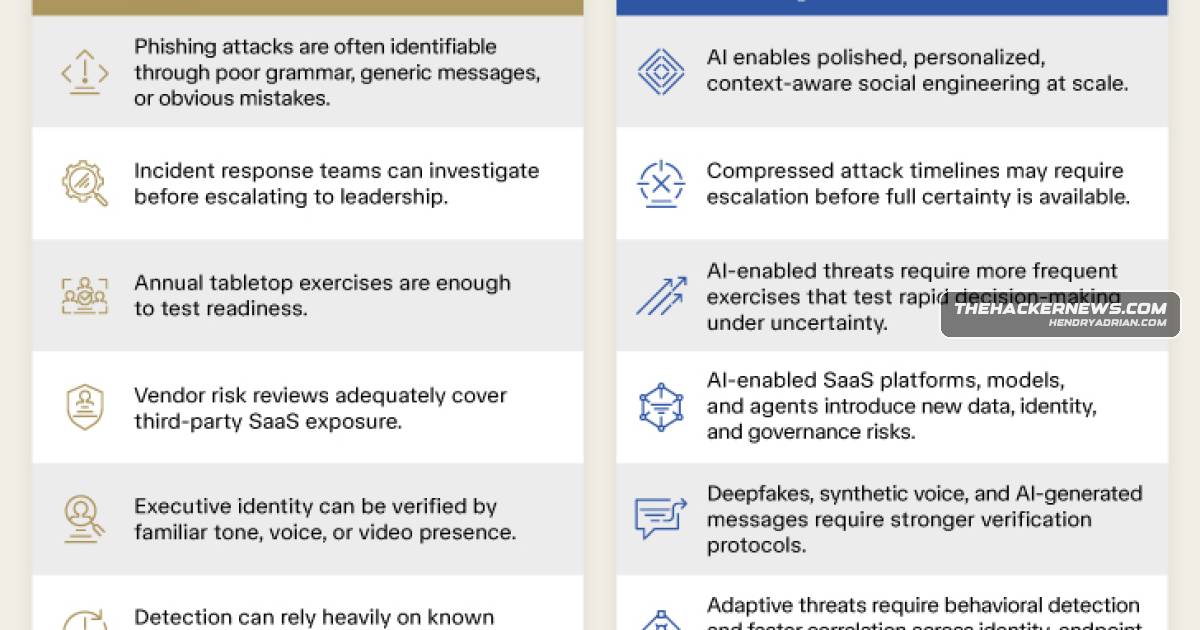
AI can accelerate social engineering, reconnaissance, and malware adaptation, compressing response time. The article recommends stronger identity checks, behavioral detection, AI governance, and exercises that test decisions under uncertainty.
Key points
- AI-enabled attacks may shorten the time defenders have to investigate and contain threats.
- The article recommends verifying sensitive requests, including payment changes, credential resets, and urgent executive instructions, through trusted channels.
- Organizations should prepare for synthetic voice and deepfake impersonation by including these scenarios in incident response plans and exercises.
- It recommends strengthening behavioral detection with telemetry across identity, endpoint, cloud, email, SaaS, and network environments.
- AI governance reviews should assess data access, logging, third-party providers, unsanctioned tools, and risks from AI-enabled workflows.
- Tabletop exercises should test cross-functional coordination and containment decisions when evidence is incomplete and attribution is unconfirmed.
- A Sygnia CISO survey cited in the article found that 90% of respondents expected difficulty coordinating stakeholders during a major incident, while 75% said uncertainty about legal and communications involvement delays decisions.
Article Details
- Defense Focus
- Adapt governance, identity verification, behavioral detection, and incident response to AI-enabled attacks that compress response time.
- Detection Methods
- Prioritize behavioral analysis over reliance on static indicators, including unusual user logins, data access, SaaS activity, endpoint behavior, communication patterns, and privilege escalation.
- Correlate activity across identity, endpoint, cloud, email, collaboration, SaaS, and network environments more quickly.
- Capture and retain AI prompt, output, and activity logs to support security monitoring and investigations.
- Data Sources
- Identity and login activity
- Endpoint activity
- Cloud activity
- Email and collaboration activity
- SaaS activity
- Network activity
- AI prompt, output, and activity logs
- Defensive Actions
- Require standardized verification, including trusted out-of-band confirmation, for sensitive actions and urgent executive requests.
- Assess approved and unapproved AI tools, sensitive-data exposure, AI workflow access controls, and third-party AI platform risks.
- Define cross-functional incident decision authority, escalation thresholds, containment responsibilities, and crisis communications procedures.
- Exercise response to AI-generated phishing, synthetic voice or deepfake impersonation, compromised SaaS, credential abuse, and AI-related data exposure under compressed timelines and incomplete information.
- Review incident-response retainers and surge capacity, and establish high-urgency pathways for scope validation, business-impact assessment, compensating controls, and post-remediation verification.