
Krybit Ransomware Profile Details RaaS Operations and 0APT Feud
Summary
SOCRadar profiles Krybit’s RaaS model, double-extortion activity and 2026 feud with 0APT. Data attributed to an April panel leak showed plaintext credentials, 20 victims in negotiation and no transactions on five wallets at the time.
Key points
- Krybit was first observed in late March 2026; underground monitoring recorded an initial detection on April 3.
- The RaaS program reportedly gives affiliates 80% of ransom proceeds and offers builders for Windows, Linux, VMware ESXi and NAS devices.
- Panel data covering March 28–April 12, leaked by rival 0APT, reportedly listed two administrators, five affiliates and 20 victims in active negotiations, with demands of $40,000–$100,000.
- The leaked panel exposed plaintext credentials and five Bitcoin wallets; none showed transactions at the time of the leak.
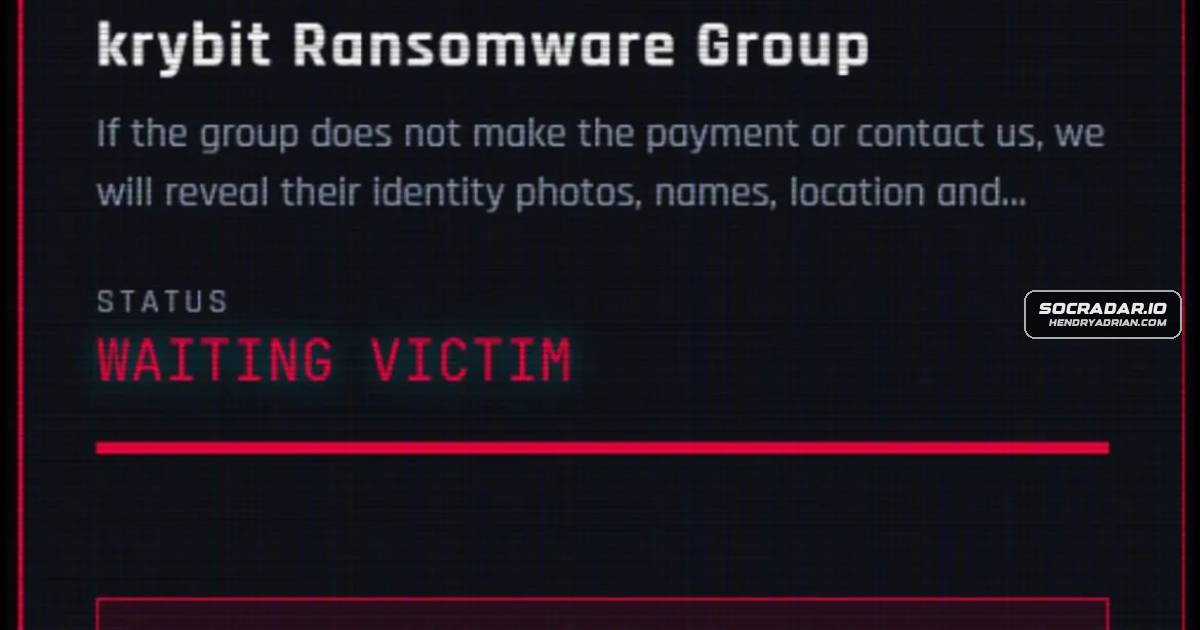
- The article says Krybit retaliated against 0APT by compromising its server and defacing its leak site.
- Reported techniques include compromised credentials and RDP access, deleting Windows shadow copies with vssadmin.exe, and appending the .KRYBIT extension. No specific phishing lure or exploited CVE was publicly attributed.
- SOCRadar’s tracker listed 70 attributed victim claims across 43 countries. The article advises checking leak-site claims against internal telemetry rather than treating them as confirmation.
Article Details
- Attack Vectors
- Affiliates commonly use compromised credentials and Remote Desktop Protocol (RDP) for initial access; the article says methods vary and does not attribute a specific phishing lure, exploited CVE, or exposed service to Krybit.
- Krybit uses double extortion: it exfiltrates data before encrypting victim systems, then pressures victims through a Tor-based data leak site and negotiation portal.
- In April 2026, 0APT breached Krybit's affiliate panel and published its contents. Krybit retaliated by compromising 0APT's server and defacing its leak site.
- Defensive Notes
- Enforce MFA on RDP, VPN, and remote administration interfaces; remove unnecessary internet exposure of remote-management ports or place them behind a VPN or jump host.
- Maintain immutable or offline backups, test restoration for ESXi and NAS environments, and alert on execution of `vssadmin.exe delete shadows /all /quiet`.
- Monitor for process injection and unusual use of legitimate system utilities; enable process-creation and script-execution logging.
- Extend monitoring coverage to Linux, ESXi, and NAS environments.
- Ingest the identified Krybit .onion infrastructure into blocklists and Tor-traffic monitoring; verify leak-site claims against internal telemetry before treating them as confirmed.
MITRE ATT&CK
T1021.001 · Remote Desktop ProtocolRemote Desktop Protocol is reported as a common entry point for Krybit affiliates.T1037 · Boot or Logon Initialization ScriptsThe article reports this persistence behavior in tracked Krybit activity but gives no specific implementation details.T1041 · Exfiltration Over C2 ChannelThe leaked affiliate panel documented 10–250GB of staged data per victim, which the article says was exfiltrated through the command-and-control channel.T1055 · Process InjectionResearcher analysis specifically describes process injection in Krybit activity.T1059 · Command and Scripting InterpreterKrybit activity is described as using script-based execution; the specific interpreter is not identified.T1071 · Application Layer ProtocolKrybit victim communications and leak-site activity are routed through Tor hidden services.T1078 · Valid AccountsCompromised credentials are reported as a common entry point used by Krybit affiliates.T1105 · Ingress Tool TransferThe article reports Krybit using Tor-based infrastructure to move data and tools.T1486 · Data Encrypted for ImpactKrybit encrypts victim files and appends the `.KRYBIT` extension.T1490 · Inhibit System RecoveryBefore encryption, Krybit runs `vssadmin.exe delete shadows /all /quiet` to delete Volume Shadow Copies.T1547 · Boot or Logon Autostart ExecutionThe article reports this persistence behavior in tracked Krybit activity but gives no specific implementation details.T1562 · Impair DefensesResearch describes Krybit defense evasion involving obfuscation, process injection, and abuse of legitimate system processes.
Threat Actors
Malware
Products
ESXiThe group provides builders for Windows, Linux, VMware ESXi, and Network Attached Storage (NAS) devices, giving affiliates coverage across an organization’s server and storage estate rather than Windows endpoints alone.LinuxThe group provides builders for Windows, Linux, VMware ESXi, and Network Attached Storage (NAS) devices, giving affiliates coverage across an organization’s server and storage estate rather than Windows endpoints alone.Microsoft WindowsThe group provides builders for Windows, Linux, VMware ESXi, and Network Attached Storage (NAS) devices, giving affiliates coverage across an organization’s server and storage estate rather than Windows endpoints alone.
Countries
BrazilGeography: The top targeted countries are Germany (10.0%), followed by a tie between Spain and Brazil for second (7.1% each).ColombiaJuly 3, 2026: MAJUHOME Concept (Malaysia) and DUFLO SAS (Colombia) added to the leak siteDominican RepublicJune 25, 2026: Dominican Republic’s tourism authority (politur.gob.do) claimed as a victimGermanyGeography: The top targeted countries are Germany (10.0%), followed by a tie between Spain and Brazil for second (7.1% each).Italy(Spain), and moscati.org (Italy)MalaysiaJuly 3, 2026: MAJUHOME Concept (Malaysia) and DUFLO SAS (Colombia) added to the leak siteMexico(Mexico), San Silvestre School (Peru), Global Software Partner S.L.Peru(Mexico), San Silvestre School (Peru), Global Software Partner S.L.SpainGeography: The top targeted countries are Germany (10.0%), followed by a tie between Spain and Brazil for second (7.1% each).Taiwan(Taiwan), AeroVision Avionics/AAI (Taiwan), B’Laofood Joint Stock Company (Vietnam), Ford Motor Company S.A.Vietnam(Taiwan), AeroVision Avionics/AAI (Taiwan), B’Laofood Joint Stock Company (Vietnam), Ford Motor Company S.A.
Industries
ManufacturingThe group targets organizations broadly across 43 countries and multiple sectors, including Professional Services, Technology, and Manufacturing.Professional ServicesThe group targets organizations broadly across 43 countries and multiple sectors, including Professional Services, Technology, and Manufacturing.TechnologyThe group targets organizations broadly across 43 countries and multiple sectors, including Professional Services, Technology, and Manufacturing.