
Researchers Demonstrate Firmware Persistence on AMD-Based Laptops
· 41:08 · Watch on YouTube ↗
Summary
Researchers demonstrated how firmware vulnerabilities and security misconfigurations on AMD-based laptops could enable persistent system management mode access after an operating system compromise.
Key points
- The research assumed an attacker had already obtained operating system kernel privileges and sought persistent access to system management mode (SMM).
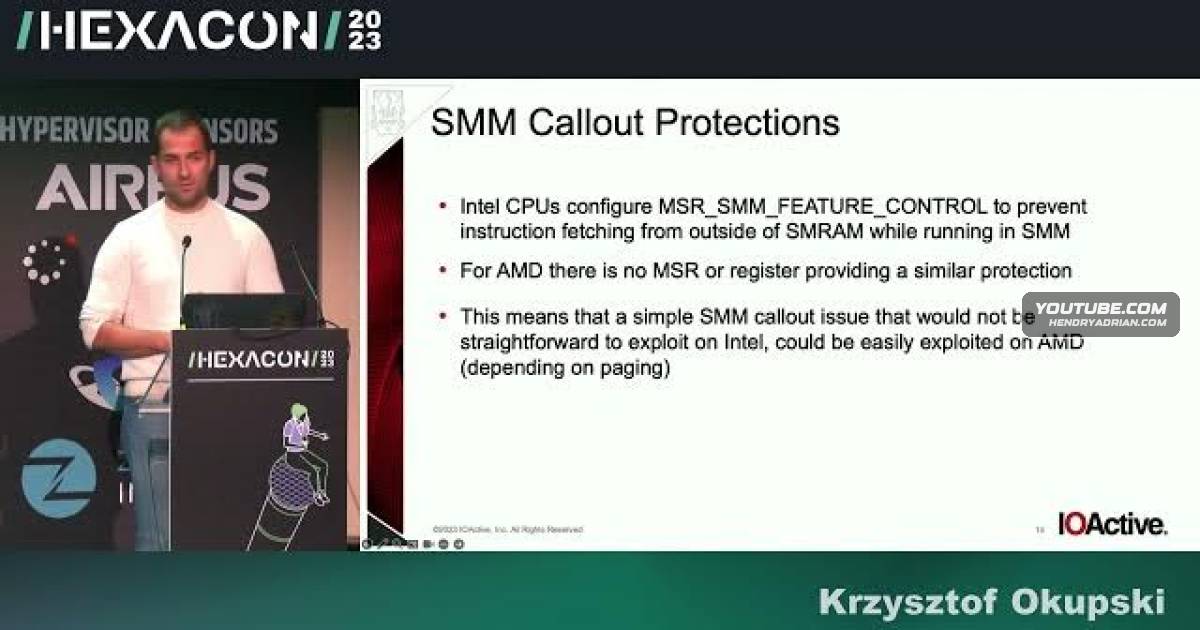
- Researchers found an unlocked SMM protection register on one system and reported that tested AMD systems generally lacked protections against SMM code execution outside protected memory.
- Unconfigured SPI flash restrictions and an SMM handler with insufficient parameter validation provided paths to manipulate firmware or SMM memory on affected systems.
- The team demonstrated a firmware backdoor that configured an SMM key at boot, allowing a second exploit to disable memory protections and access SMM code.
- On a ThinkPad p6s, researchers found that the firmware verification list omitted some firmware volumes and could itself be manipulated, despite platform secure boot being enabled.
- The researchers reported more than 20 vulnerabilities across AMD reference code and firmware suppliers. They cautioned that their reverse-engineering conclusions could contain inaccuracies.
Article Details
- Topics
- [00:56] Research setup and AMD platform security documentation
- [03:26] SMM memory protections and configuration weaknesses
- [08:51] SPI flash protections and firmware access vulnerabilities
- [18:35] AMD ROM Armor and SMM interface weaknesses
- [25:28] Platform secure boot configuration and firmware persistence demonstration
- [36:07] Firmware verification weaknesses in ThinkPad p6s
- [39:30] Disclosure findings and configuration checks