
A Year of Fuzzing XNU Mach IPC Uncovers Kernel Vulnerabilities
· 28:28 · Watch on YouTube ↗
Summary
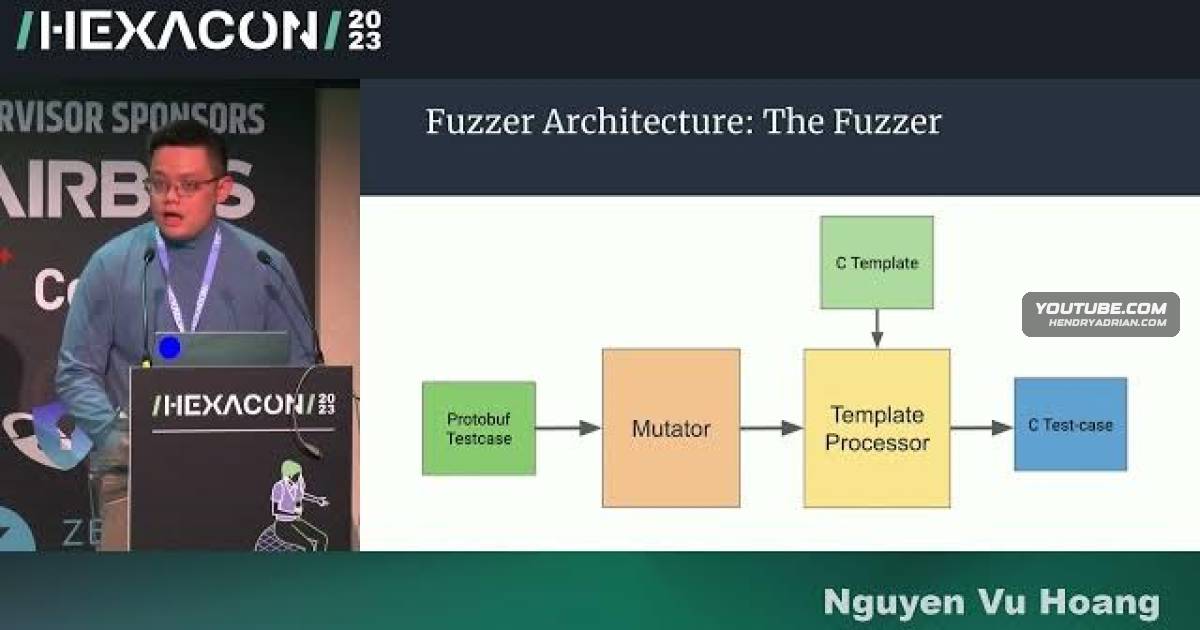
A researcher presents a template-based fuzzer for XNU Mach IPC, using generated C tests, mutation strategies and kernel-panic monitoring. The talk details kernel vulnerabilities and says Apple patched one in iOS 15.6.1.
Key points
- The presenter analyzes XNU Mach IPC bugs, including a type-confusion issue and a user-data element use-after-free, and describes fixes involving checks or locking.
- A template-based fuzzer combines structured test cases with annotated C templates to generate executable Mach IPC test programs.
- Its mutator changes function arguments and call order, applies function-specific probabilities, and targets edge cases to improve kernel code coverage.
- A harness records each running test case and monitors Mac OS virtual machines for kernel panics through serial consoles.
- The detailed vulnerability involved unchecked indexing in IPC request handling and overlapping union fields; crafted Mach messages could corrupt kernel memory.
- The presenter says he reproduced the issue on an iPhone 11 running iOS 15.6 and that Apple released a hotfix in iOS 15.6.1.
- The talk recommends combining fuzzing with code auditing and a strong understanding of the target.
Article Details
- Topics
- [00:15] Research scope: hunting vulnerabilities in XNU and the talk's structure
- [01:09] Root causes and fixes for previously discussed Mach IPC vulnerabilities
- [05:06] Design and implementation of a template-based XNU fuzzer
- [16:23] Recording test cases and monitoring kernel panics in virtual machines
- [19:32] Detailed IPC request vulnerability, trigger conditions, and kernel memory corruption
- [27:15] iOS 15.6 testing, the iOS 15.6.1 hotfix, and research takeaways