
Researcher Details Hyper-V Use-After-Free Bug and $200,000 Bounty
· 34:48 · Watch on YouTube ↗
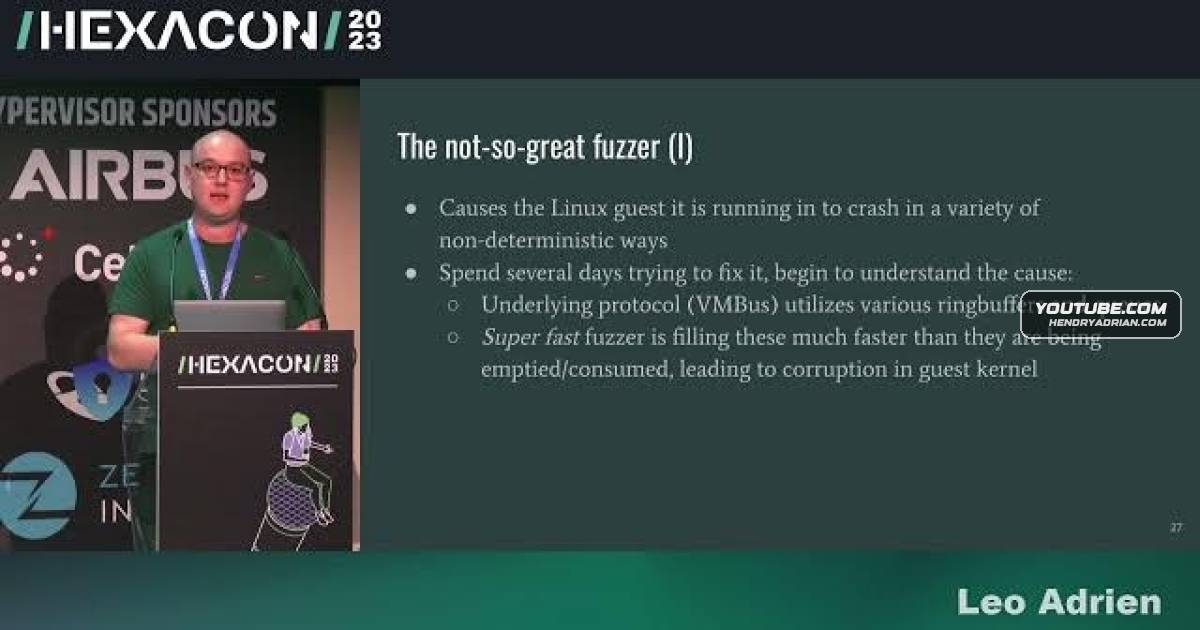
Summary
Leo Adrien explains how he reproduced a Hyper-V VMBus use-after-free that crashed the host, reported it to Microsoft and received a bounty. Microsoft classified the issue as remote code execution.
Key points
- An initial storage fuzzing experiment unexpectedly triggered a host crash in the VMBus packet-processing stack.
- A malformed packet could be freed without being removed from a linked list, causing a use-after-free during subsequent iteration.
- Adrien reproduced the crash by coordinating valid and malformed packets with a separate worker thread to affect the lookaside-list cache.
- The researcher found no obvious route to code execution, but said Microsoft classified the issue as remote code execution and credited him on an existing CVE.
- The reported fix avoided freeing the malformed packet at the problematic point.
- The talk highlights how custom allocators and multithreading can obscure memory-safety bugs during testing.
Article Details
- Topics
- [01:04] Hyper-V architecture and virtualization attack surface
- [03:52] VMBus shared-memory communication
- [06:21] Stateful fuzzing and the unexpected host crash
- [12:02] Use-after-free triage and VMBus packet processing
- [20:19] Lookaside-list allocation and cache behavior
- [26:02] Worker-thread timing and crash reproduction
- [30:57] Exploitability, Microsoft classification and fix
- [32:02] Lessons for vulnerability research and allocator debugging