
Researchers Demonstrate Zero-Click RCE on Tesla Model 3 via TPMS Sensors
· 23:34 · Watch on YouTube ↗
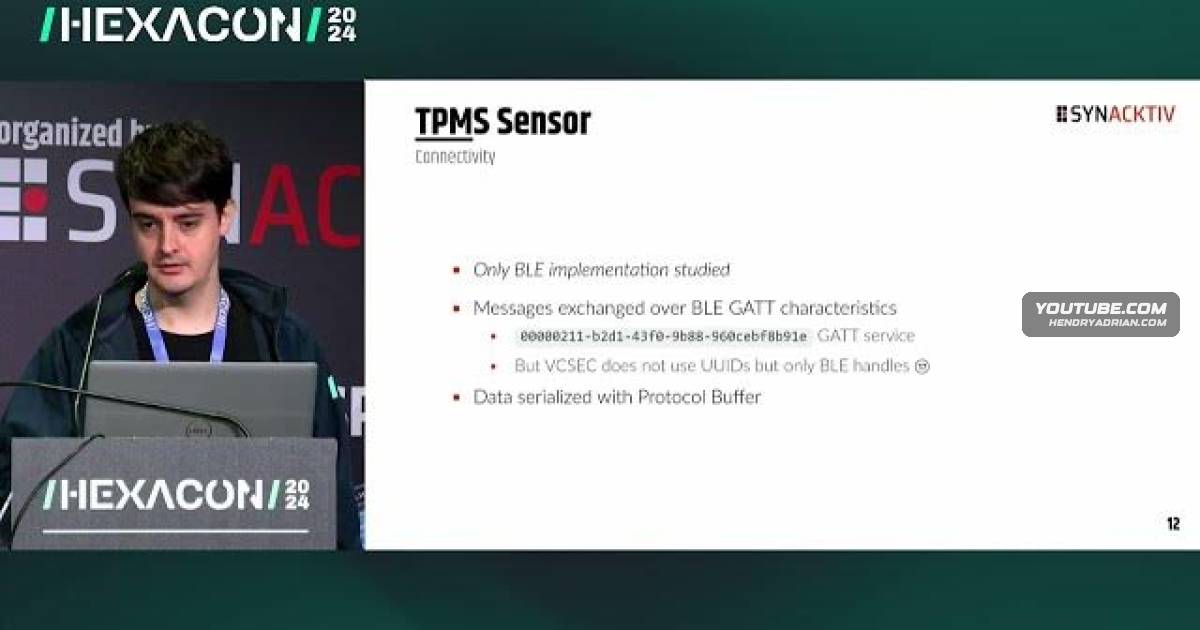
Summary
Researchers demonstrated remote code execution on the Tesla Model 3’s VCC through a TPMS enrollment certificate overflow. The exploit enabled arbitrary CAN messages; Tesla released updated firmware with additional checks.
Key points
- Researchers found an integer overflow in the certificate-chunk start-index check during TPMS enrollment, enabling an out-of-bounds write in the VCC.
- The write could overwrite a function pointer and redirect execution to attacker-controlled code; certificate signature validation occurred afterward.
- The exploit used two ESP32 devices to interfere with a sensor connection and simulate a TPMS sensor during the vehicle’s auto-learn process.
- As proof of exploitation, the researchers sent arbitrary messages on the vehicle CAN bus. They said VCC code execution could enable actions such as opening the car and starting it.
- The vulnerability affected VCC firmware config ID24, released for recent Model 3 vehicles from October 2023; the researchers confirmed it on production hardware.
- Tesla provided hardware for testing and quickly released a new firmware version with additional checks.
Article Details
- Topics
- [00:00] Researchers’ prior Tesla security work and the current investigation
- [01:22] VCC architecture and its role in vehicle access control and TPMS
- [03:36] Firmware acquisition and reverse-engineering methods
- [05:30] TPMS communications, enrollment, and message formats
- [09:12] Certificate-chunk overflow and function-pointer overwrite
- [17:27] Triggering the vulnerability through TPMS auto-learning and an ESP32-based race
- [21:38] Proof of code execution, potential impact, and Tesla’s firmware fix