
Sergei Volokitin Demonstrates USB-over-SPI Exploit That Extracts an HSM Private Key
· 19:02 · Watch on YouTube ↗
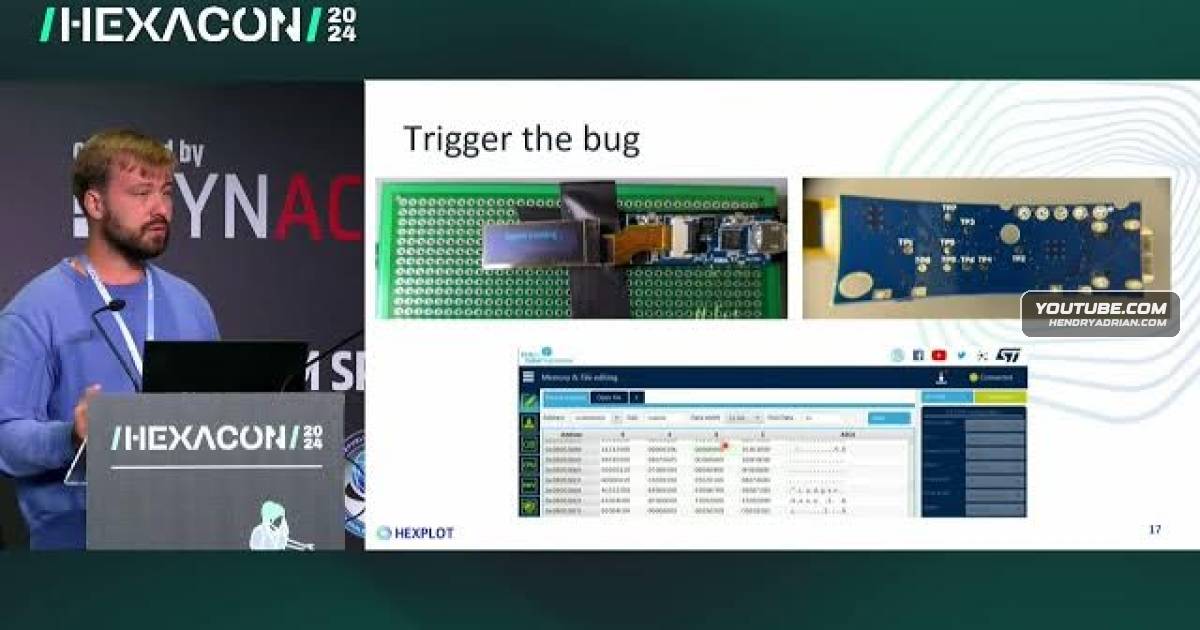
Summary
Sergei Volokitin describes a USB-over-SPI out-of-bounds write in an HSM based on Ledger hardware. With physical JTAG access to its MCU, the exploit chain enables code execution and private-key extraction; Ledger fixed the bugs.
Key points
- The HSM uses an STM32 microcontroller to relay USB data over SPI to a secure element; the researcher treats the MCU and USB input as untrusted.
- Volokitin found an attacker-controlled SPI buffer index that allows out-of-bounds writes to global USB endpoint data in both the UI and signer applications.
- Physical access to the device's JTAG port lets an attacker run code on the MCU and send crafted SPI data to the secure element.
- The proof of concept corrupts callback data and uses persistent flash writes to alter code, then changes the public-key response path to return the private key.
- Volokitin says he reported the proof of concept to the vendor and that the bugs were fixed by porting missing patches from the Ledger SDK.
- The talk highlights limited mitigations in low-level devices and the risk of patches not propagating across products.
Article Details
- Topics
- [01:19] HSM functions and security expectations
- [02:43] Ledger-based HSM architecture
- [05:01] Attacker model and device trust boundaries
- [10:12] Physical JTAG access and code execution on the MCU
- [12:14] Memory protections and persistent flash writes
- [16:02] Proof of concept for private-key extraction
- [17:34] Fixes and lessons on mitigations and patch propagation
- USB-over-SPI flaw and out-of-bounds write discovery