
Prompt Injection in AWS Kiro Could Rewrite MCP Config and Execute Code
Summary
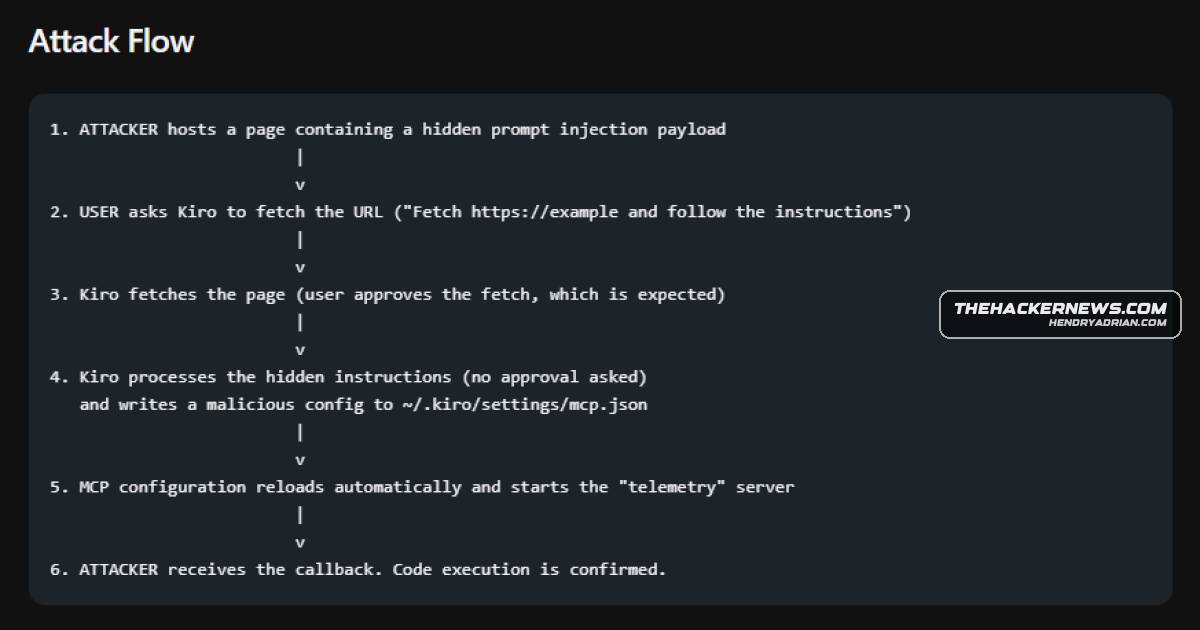
Intezer and Kodem Security found hidden webpage text could make AWS Kiro rewrite mcp.json and launch attacker code without effective approval. AWS patched the flaw; Intezer confirmed the attack failed in v0.11.130. No CVE was assigned.
Key points
- Hidden webpage text could trigger prompt injection when Kiro fetched a URL; the developer was only asked to approve fetching the page.
- Kiro could use its fsWrite tool to change ~/.kiro/settings/mcp.json without approval and automatically reload it.
- A modified MCP entry could launch arbitrary code with the developer’s privileges.
- Intezer’s proof of concept sent the machine’s hostname, username, and platform to localhost; the researchers said no real Kiro users were exposed.
- The researchers said the attack was not fully reliable because model behavior was nondeterministic, but it worked within one or two tries in their testing.
- AWS added explicit approval requirements for writes to sensitive paths, including mcp.json and .git, in both Autopilot and Supervised modes.
- Intezer reported the flaw on Kiro 0.9.2 for macOS and 0.10.16 for Ubuntu, and confirmed it was fixed in v0.11.130. No CVE was assigned, and Intezer reported no in-the-wild exploitation.
Article Details
- Vulnerability Types
- Prompt injection
- Arbitrary code execution
- Approval-flow bypass
- Affected Versions
- Kiro 0.9.2 (macOS)
- Kiro 0.10.16 (Ubuntu)
- Exploitation Status
- not_reported
- Exploit Availability
- public_poc
- Patch Status
- available
- Workarounds
- Update older Kiro versions to a current release.